Sports Card Value Guide
PSA Card Values: What Changes the Price and How to Check Yours
Learn how PSA card values are determined, what affects PSA graded card prices, and the best ways to check baseball, basketball, and football card values before you buy or sell.
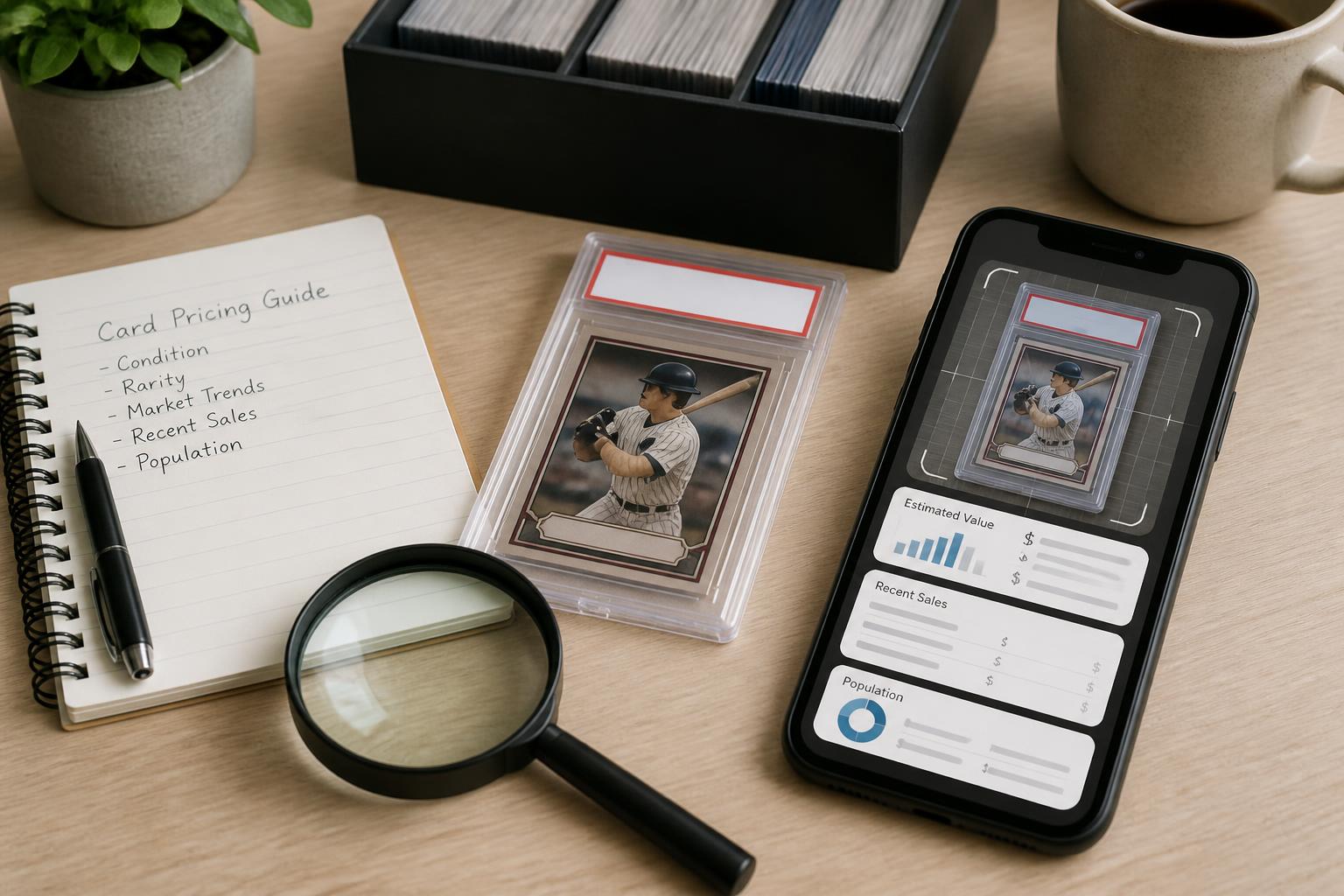
PSA card values can vary a lot from one card to the next, even when the player and set are the same. The grade, sport, year, print run, and recent sales all matter. If you want a realistic estimate of what a card is worth, you need to look at the card as a whole, not just the name on the label.
This guide explains how to check PSA card values, what drives PSA graded card prices, and how to evaluate baseball, basketball, and football cards without guessing. It also shows a simple way to compare graded card value using recent market data.
Check current eBay listings for key popular rookie cards cards
- 1989 Upper Deck #1 Ken Griffey Jr. on eBay
- 1986 Fleer #57 Michael Jordan on eBay
- 1993 SP #279 Derek Jeter on eBay
We may earn a commission from eBay purchases made through these links (eBay Partner Network).
What PSA card values mean
When collectors talk about PSA card values, they usually mean the market price of a card that has been authenticated and graded by PSA. The grade matters because the same card can sell for very different amounts depending on whether it is PSA 1, PSA 6, PSA 9, or PSA 10.
That is why a PSA card price is not the same as the value of a raw card. A clean, ungraded card may be worth less than a lower-grade slabbed copy, while a high-grade example can sell for much more if demand is strong.
The main factors that affect graded card prices
Most graded card prices come down to a few core variables. If you understand these, you can judge whether a listing looks fair or overpriced.
| Factor | Why it matters | What to check |
|---|---|---|
| PSA grade | Higher grades usually sell for more | Pop report, centering, corners, edges, surface |
| Player demand | Popular stars and rookies bring stronger prices | Current collector interest and recent sales |
| Sport | Baseball, basketball, and football markets behave differently | Compare against sport-specific sold comps |
| Year and set | Key rookie years and iconic sets often carry premiums | Card issue, checklist importance, scarcity |
| Print volume and scarcity | Lower supply can support higher prices | Short prints, inserts, parallels, and population |
| Eye appeal | Strong visuals can affect buyer interest | Centering, gloss, image quality, overall presentation |
How PSA grading changes card value
PSA graded card prices often rise sharply when a card moves into the top condition tiers. For modern cards, the gap between PSA 9 and PSA 10 can be meaningful. For older cards, even PSA 5, PSA 6, or PSA 7 copies may carry strong value if the card is scarce or important to the set.
Condition is not just about the final grade label. Two PSA 8 cards can still differ in price because one may have stronger centering or better eye appeal than the other. That is why graded card value should be compared using sold listings, not asking prices alone.
Quick condition checklist
- Check centering on the front and back.
- Look for corner wear or soft corners.
- Inspect edges for chipping, whitening, or rough cuts.
- Review the surface for scratches, print lines, or stains.
- Compare the card to recent sold PSA examples in the same grade.
Sport-specific price patterns to watch
PSA baseball card values, PSA basketball card values, and PSA football card value trends do not always move together. A card that is common in one sport may be a major chase in another. It helps to compare within the same sport and era.
PSA baseball card values
Baseball values often depend on rookie cards, Hall of Famers, and classic vintage issues. A strong baseball card can have steady demand, especially when it is part of a recognizable rookie class or an iconic set.
If you are checking a baseball card and want a sense of how different player profiles affect pricing, related player guides like Joe Magrane Baseball Card Value and Johnny Bench Baseball Card Value can help you see how specific cards are priced.
PSA basketball card values
Basketball card prices tend to be especially sensitive to player popularity, rookie year demand, and grade. Modern basketball cards can change quickly based on collector interest, while vintage stars may be more stable. For a related example, see Shaq Basketball Card Value.
PSA football card value
Football cards can have a wider price spread depending on whether the card is a rookie, a short print, or a standard issue from a common set. Quarterbacks often lead demand, but defensive stars and legends can also perform well in higher grades. If you are looking at football pricing, compare sold comps closely because PSA football card value can shift with player news and collector attention.
How to check PSA card values step by step
The most reliable way to check PSA card values is to compare your card to recent sales of the same card, same grade, and same sport. Here is a simple process.
- Identify the exact card by player, year, set, and card number.
- Confirm whether it is raw or PSA graded.
- Match the PSA grade as closely as possible.
- Review recent sold listings, not just active listings.
- Look at at least a few sales to avoid one-off outliers.
- Adjust for condition details, centering, and eye appeal.
If you are comparing a PSA card price, it helps to sort results by grade and date. A sale from last week is usually more useful than a listing that has not sold yet. For a broad market check across sports, a general basketball card value lookup style search can also show how graded card prices compare across similar cards.
Best ways to compare sold comps
Sold comps are the backbone of good pricing. They show what buyers actually paid, which is more useful than asking prices or wishful listings.
- Use the same card number whenever possible.
- Keep grades consistent. PSA 8 and PSA 9 can be very different.
- Watch for auction timing, since late bidding can push prices up.
- Check whether the card is a true base card, insert, parallel, or short print.
- Compare several recent sales to establish a realistic range.
If you are evaluating a star rookie or a sought-after issue, a broader market context can help. Our guide to Most Expensive Rookie Card Value explains why rookie demand can change pricing so much.
Using a scanner or lookup tool
If you check cards often, a scanner app can save time by helping you identify cards faster and compare pricing without manually searching every set. The ScoutCard scanner on the App Store is a practical option for quick lookups, especially when you are sorting a box or deciding whether to list a card.
Download ScoutCard on the App Store if you want a faster way to scan cards and review value estimates while you work through your collection.
When PSA card values are easiest to estimate
Some cards are easier to price than others. Standard rookie cards from major sets with plenty of recent sales are usually straightforward. Harder cases include low-pop vintage cards, obscure players, and cards with very few comparable sales.
- Easier to estimate: common modern stars, known rookies, highly traded cards
- Harder to estimate: rare inserts, older low-pop cards, niche players, unusual grades
When comps are thin, use a range instead of a single number. That gives you a better read on graded card value without overcommitting to one sale.
FAQ
Do PSA card values always go up with a higher grade?
Usually, but not always. The jump from one grade to the next depends on the card, the sport, supply, and demand. Some cards see a big premium for top grades, while others show a smaller difference.
What is the difference between PSA card price and graded card value?
PSA card price is the market amount a buyer pays for a specific PSA-graded card. Graded card value is the broader estimated worth based on recent sales, grade, and current demand.
Should I use asking prices to check PSA card values?
Asking prices can help with context, but sold comps are better. Sold listings show what the market actually accepted, which is more useful than active listings that may never sell.
Are PSA baseball card values higher than basketball or football?
Not by default. Each sport has its own demand patterns. Some baseball cards are stronger than comparable football cards, while certain basketball rookies can outpace both. Always compare within the same sport and era.
What is the fastest way to check a card’s worth?
Identify the exact card, match the PSA grade, and compare several recent sold comps. If you scan cards often, a tool like ScoutCard can speed up the process.
Bottom line
PSA card values depend on more than a grade label. The sport, player, set, condition, and recent sales all shape the final number. If you want a reliable estimate, compare sold comps in the same grade and use the card’s actual market history instead of guessing from hype or asking prices.
For faster lookups, consider using the ScoutCard scanner and keeping your searches focused on the same card, same grade, and same sport. That approach gives you a much clearer read on PSA graded card prices and the real value of the card in hand.
Try the Sportscardvalue app
Use the app when you want a faster photo-based check before comparing details manually.