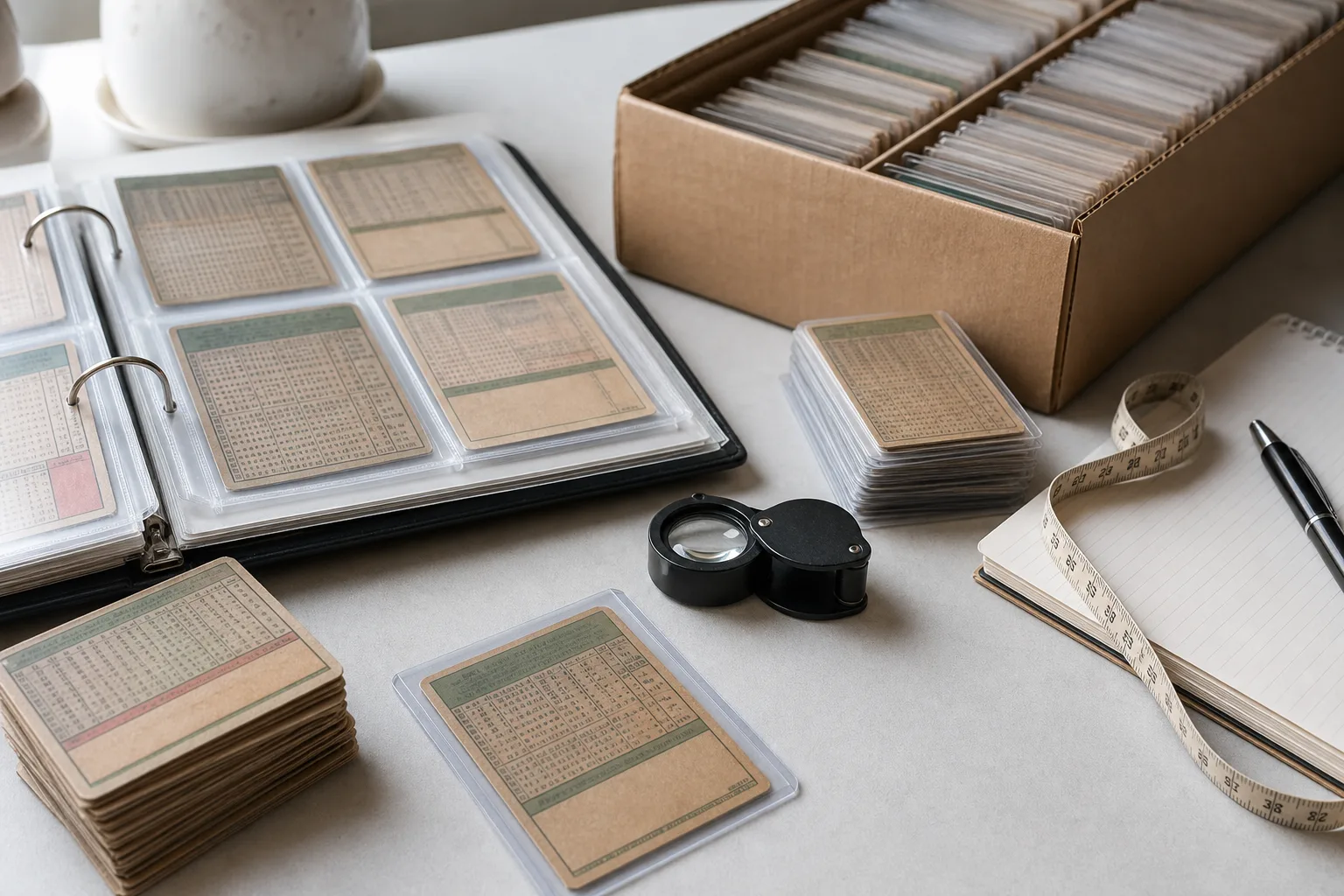
Ken Griffey Jr. card value depends on the exact issue, its condition, whether it is professionally graded, and what closely matched copies have actually sold for. Start by identifying the year, brand, set, card number, and variation; then compare sold examples in the same condition rather than relying on an asking price. Price databases and marketplaces both show that Griffey cards span very different price levels. Source (accessed August 12, 2026) Source (accessed August 12, 2026)
Check current eBay listings for key Ken Griffey Jr. cards
We may earn a commission from eBay purchases made through these links (eBay Partner Network).
Start with the exact card, not the player name
A binder page marked “Ken Griffey” is not enough to value a card confidently. Ken Griffey Jr. has cards from many releases, including inexpensive mass-produced issues and premium inserts, autographs, memorabilia cards, parallels, and graded examples. The same player can appear in cards with very different collector demand. Marketplace category pages also combine a large mix of Griffey cards, so a broad search result is only a starting point for identification. Source (accessed August 12, 2026)
Identification checklist
- Read the copyright year and brand name on the front or back.
- Find the set name, card number, and any insert, parallel, autograph, or memorabilia wording.
- Compare the player photograph, border treatment, logo placement, and back design with a checklist or a confirmed sale.
- Look for variation clues, including different backs, print marks, serial numbering, foil, refractor-style finishes, or signature authentication.
- Confirm that the card names Ken Griffey Jr., not Ken Griffey Sr. Their cards are separate collectibles and should not be compared merely because they share a surname.
If the label is hard to read, photograph both sides in even light. ScoutCard can be a useful starting point for organizing what the card appears to be, but confirm the set and variation before treating any market comparison as a match. For a broader photo-to-comparison workflow, see the trading card value checker.
Recognizing the well-known early Griffey issues
The Source (accessed August 12, 2026). It is a particularly important card to identify exactly because its visual appeal and grading sensitivity make condition central to the comparison.
Search results also separately surface the 1989 Upper Deck and 1989 Donruss releases in a Griffey price search. That does not mean the cards are interchangeable: brand, set, print run characteristics, card design, and collector preference can lead to different results. Source (accessed August 12, 2026)
Topps-branded Griffey cards deserve the same careful treatment. Identify the precise release rather than using “Topps card” as the whole description. A base card, a traded or update-style issue, a reprint, and a later insert can all look related in a quick search while being different cards. The same principle applies to popular prospect-era cards and later high-demand releases: popularity alone does not establish that a card is a recognized rookie card.
Use sold comparables, not hopeful listings
Active listings show what sellers want to receive; completed transactions are more useful evidence of what a buyer recently paid. SportLots describes its player values as based on real selling prices, while eBay’s Griffey page is a for-sale marketplace category. Use those different page types for different jobs: listings help locate cards and variations, while sold-price records help estimate market value. Source (accessed August 12, 2026) Source (accessed August 12, 2026)
- Search using the year, brand, set, card number, and “Ken Griffey Jr.”
- Exclude results that are lots, reprints, slabs with a different grade, signed copies, or a different variation.
- Review several recent sales of the same card format: raw compared with raw, or the same grading company and grade compared with the same.
- Set aside unusual results when the listing includes a scarce variation, an autograph, an exceptional grade, unusual provenance, or multiple cards.
- Use the middle of the relevant comparable group as an estimate range, then adjust cautiously for your card’s visible condition.
A price guide is a reference point, not a guaranteed offer. The practical question is whether the comparable card is truly the same issue and whether its condition is genuinely comparable to yours. This is why a photographed card and a specific sales search are more useful than a player-name-only estimate.
Why condition and grading can change the result
For early Griffey cards, small flaws can matter: uneven centering, softened corners, edge wear, print defects, surface scratches, stains, creases, and loss of gloss can move a card into a different condition tier. A card can look sharp in a sleeve yet show flaws when viewed flat under light. Describe those flaws honestly when searching for raw-card comparables.
Professionally graded cards should be compared by both grade and grading company. Do not assume a raw card will achieve the grade shown on a high-priced slab, and do not use a slab sale as the primary comparable for an ungraded card. The PSA card values overview can help frame a grade-aware comparison before you decide whether submitting a card makes sense.
| Card state | Best comparison target | What to check |
| Raw card | Recent raw sales of the exact issue | Centering, corners, edges, surface, and clear photos |
| Graded card | Recent sales with the same company and grade | Certification details, label variation, and sale format |
| Autographed card | Comparable authenticated autograph sales | Authentication, signature placement, and card condition |
| Memorabilia or serial-numbered card | Sales of the same parallel or memorabilia version | Exact parallel, numbering, patch characteristics, and condition |
Decide whether to sell, grade, or keep it
Consider selling raw when the card has clear condition issues, when the likely added value does not appear to cover grading and selling costs, or when a buyer can readily assess it from detailed images. Consider grading only after you have identified the exact card, inspected it closely, and compared raw and graded sales that actually match. Grading is an evaluation outcome, not a promise of a particular grade or resale result.
An auction can expose a desirable card to competing bidders, while a fixed-price listing gives you more control over the asking amount. A dealer sale may be simpler but can trade convenience for a lower offer. Before choosing, calculate expected take-home proceeds rather than focusing only on the gross sale: marketplace fees, payment processing, shipping, insurance, supplies, returns, and grading costs can all affect the result.
Keep the estimate realistic and updateable
Market value is the evidence-based amount a buyer may pay in the current market. It is different from an insurance or replacement figure, and different again from your net proceeds after costs. Recheck relevant sold comparisons near the time you list because demand, available supply, and the mix of recent sales can change.
For additional context on comparing baseball-card eras and condition, see the Rickey Henderson baseball card values, the Sammy Sosa baseball card value guide, and the Mickey Mantle rookie card value article. The most defensible Ken Griffey Jr. value is not a permanent number: it is a documented conclusion based on the right card, honest condition assessment, and recent comparable sales.
Quick answer: are most Ken Griffey Jr. cards valuable?
Some are actively collected, but a player name alone does not determine value. Identify the exact issue first, then compare recent sales in the same condition. Early mass-produced cards, recognized rookie-era cards, premium inserts, autographs, memorabilia cards, and high-grade examples should not be treated as one price category.
What if my card says Ken Griffey instead of Ken Griffey Jr.?
Check the full player name, photograph, career era, and card back before searching prices. Ken Griffey Sr. is a different player, so his cards require separate identification and separate comparable sales.