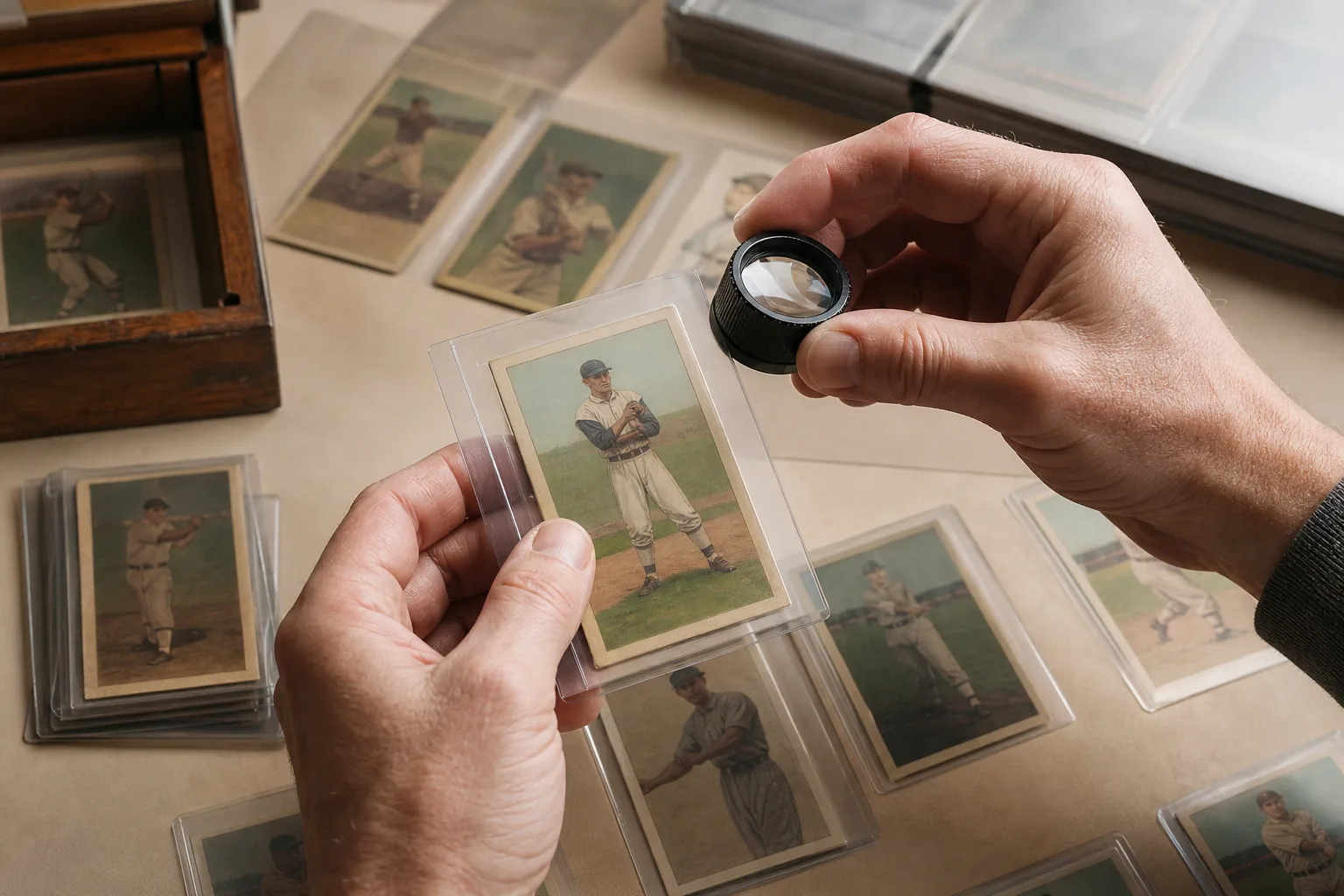
The Mickey Mantle rookie card most collectors mean is the 1952 Topps #311. Its value can range dramatically because authenticity, grade, eye appeal, and the sale method matter as much as the card’s name. A price-listing snapshot displays $26,960.00 for an ungraded example and $4,040,000.00 for PSA 10, but those displayed figures are reference points—not guaranteed offers, auction results, or proceeds you will receive. https://www.sportscardspro.com/game/baseball-cards-1952-topps/mickey-mantle-311 (accessed 2026-08-07)
Check current eBay listings for key Mickey Mantle cards
We may earn a commission from eBay purchases made through these links (eBay Partner Network).
Start by identifying the card, not the asking price
For this page, “Mantle rookie card” refers to the hobby listing convention for the 1952 Topps Mickey Mantle #311. Before comparing it with a sale or a price guide, confirm that your card actually matches that issue. A Mantle card from another set can still be collectible and valuable, but it should not be priced as #311.
| Identifier | What to check | Why it matters |
|---|---|---|
| Set and year | Confirm that the card is identified as 1952 Topps. | Do not substitute a later Topps issue, a Bowman card, or a commemorative product into a #311 comparison. |
| Card number | Check for #311 on the card and compare both front and back with reliable reference images. | The card number is the quickest way to separate the issue from other Mantle cards. |
| Format and print | Compare dimensions, stock, color, borders, printing texture, and back layout against authenticated examples. | Reprints, altered cards, and mismatched fronts or backs should not be valued like an original. |
| Specific card | Record every qualifier: raw or encapsulated, grading company, label language, grade, qualifiers, and visible defects. | A similar-looking card can carry a very different market position once these details change. |
The source listing identifies the relevant card as Mickey Mantle #311 in the 1952 Topps set. https://www.sportscardspro.com/game/baseball-cards-1952-topps/mickey-mantle-311 (accessed 2026-08-07)
Use published values as a starting point, not a promise
The most useful comparable is not simply another Mantle card. It is a card with the same issue, a similar authentication status, similar grading outcome, comparable eye appeal, and a documented completed sale. A dealer’s asking price may reflect a hopeful target; an auction hammer price may exclude buyer charges; and a seller’s net proceeds can be lower after consignment, marketplace, shipping, insurance, and payment costs.
| Reference point | Displayed figure | Proper use |
|---|---|---|
| 1952 Topps #311, ungraded | $26,960.00 | Use only as a broad listing reference after authenticity and condition have been assessed. |
| 1952 Topps #311, PSA 10 | $4,040,000.00 | Do not apply to a raw, lower-grade, altered, or materially different-looking example. |
These are figures displayed on a price-listing page, rather than verified sale terms for your specific card. Treat the gap between the two entries as a reminder that grade and condition can dominate the valuation. https://www.sportscardspro.com/game/baseball-cards-1952-topps/mickey-mantle-311 (accessed 2026-08-07)
Why two examples can look alike but sell far apart
On a vintage card with large colored borders, centering is often immediately visible. A card may have intact corners yet present poorly if the image is shifted noticeably toward one edge. Conversely, a card with a modest technical flaw can sometimes show better than its assigned grade. That is why clear front-and-back photographs matter when comparing cards.
- Centering: Look at the border balance on every side, not just whether the player image appears centered.
- Corners and edges: Note rounding, fraying, chipping, layering, and whether the wear is consistent across the card.
- Surface: Check for gloss loss, scratches, wrinkles, paper loss, writing, wax or gum residue, stains, and evidence of cleaning.
- Creases: Photograph the card at an angle. A crease can be difficult to see in a straight-on scan but can substantially change buyer interest.
- Print and color: Compare ink, registration, and color appearance carefully. Do not assume an unusual look is a rare variation.
- Alteration risk: Trimmed edges, recolored areas, rebuilt corners, pressed creases, and removed marks can change how buyers and graders treat a card.
What grading changes—and what it does not
A professional holder can make a card easier for a buyer to evaluate, but the label should be read in full. A numerical grade, an authentic-only result, an altered designation, a qualifier, or an evidentiary problem are different outcomes. They should not be treated as interchangeable when you compare values.
Check the holder for the grading company, certification number, stated grade or designation, and any qualifier. Then verify the certification through the grading company before committing to a purchase or setting a sale price. If the card is raw, do not describe it as equivalent to a graded copy merely because it appears clean in one photograph.
For a broader explanation of why a label and condition affect card pricing, see PSA Card Values: What Changes the Price and How to Check Yours. If you are deciding whether submission costs and waiting time make sense, first gather strong photos and a realistic range of relevant comparables.
A safer appraisal workflow for a raw card
- Photograph the front and back in even, indirect light, then add angled images that reveal surface issues and creases.
- Capture close-ups of all corners, all edges, the card number, and any area that could be questioned.
- Write down exactly what you have: 1952 Topps #311, raw or graded status, visible flaws, dimensions, and any provenance you can document.
- Separate completed sales from active listings. Compare only cards that are genuinely close in grade, presentation, and authentication status.
- Ask a vintage-card specialist for an opinion if authenticity or alteration is uncertain. Do this before publicly marketing a high-value card.
- Use ScoutCard to organize your initial scan and valuation research, then validate an important card with photographs, certification records, and specialist review.
Our Trading Card Value Checker: Fast Ways to Price a Card explains a practical way to move from identification to comparable research without treating a single listing as a final answer.
Do not confuse other Mantle cards with this issue
Mantle appeared in more than one card set and in later issues. A card can be a desirable Mantle collectible without being the 1952 Topps #311 used for the value discussion above. Start each comparison with the set name, card number, and the exact front-and-back design. If those details differ, build a separate group of comparables rather than adjusting a #311 price by guesswork.
The same discipline helps with other vintage stars. See our Honus Wagner Baseball Card Value and Rickey Henderson Baseball Card Values by Condition and Set for examples of why set identity and condition must come before a headline price.
Buying, selling, storage, and insurance
If you are buying, request high-resolution images, holder and certification details when applicable, and a clear return policy. Avoid relying on cropped scans, vague “mint” descriptions, social-media claims, or a seller’s comparison to a record-setting example.
If you are selling, preserve the card’s current state. Do not clean, flatten, recolor, trim, tape, or otherwise attempt an amateur repair. Place a raw card in an appropriately sized protective sleeve and rigid holder, keep it away from heat, humidity, and direct light, and document its condition before shipping or submitting it. For a potentially significant item, discuss insurance limits and coverage terms with an insurer before it leaves your possession.
For more collecting and pricing context, browse the Sports Card Guides. The sensible next step is not to select the highest visible number: confirm the issue, document condition honestly, verify authentication, and compare against evidence that truly matches your card.
Is the headline record sale the value of my card?
No. A headline sale can describe an unusually strong example, unusual bidder demand, or a specific sale setting. It is not a substitute for matching your card’s authenticity, grade, eye appeal, and condition to documented comparables.
Should an ungraded card be sold as a high-grade example?
No. Describe a raw card as raw, provide clear photographs, disclose known flaws, and let an informed buyer or grading service assess it. If the card may have substantial value, seek qualified authentication advice before marketing it.